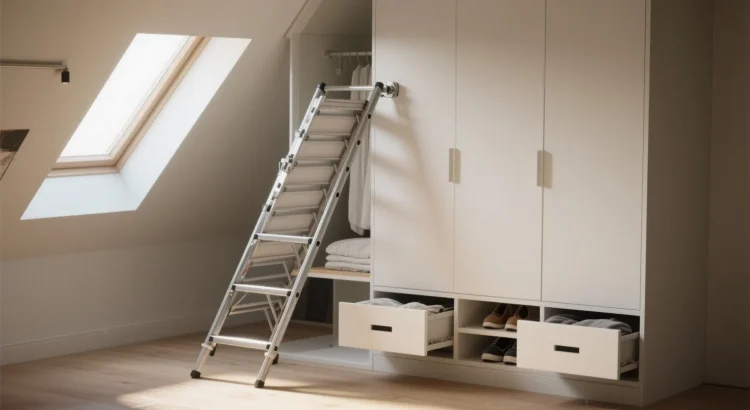
Loft ladders are essential tools for accessing attic spaces, offering convenience and saving space compared to traditional staircases. Among the most popular options available today are folding and sliding Loft Ladder. While both types serve the same primary purpose of providing safe access to a loft or attic, they differ in design, functionality, installation requirements, and space efficiency. Understanding these differences can help homeowners make an informed choice that fits their needs and interior layout.
Folding loft ladders are designed to collapse into sections, which then fold neatly under the loft hatch when not in use. This design allows the ladder to occupy minimal space in the ceiling, making it ideal for homes with low ceilings or compact areas. Folding loft ladders often come in two-section or three-section configurations, depending on the height of the loft. The folding mechanism is generally straightforward, and the ladder can be operated manually without much effort. One of the main advantages of folding loft ladders is their compact storage and ease of installation. They are lightweight, cost-effective, and suitable for most domestic settings where space-saving is a priority.
Yes, many homeowners undertake this as a DIY project. Sliding aluminum ladders are the easiest to install. However, integrated timber folding ladders often come with the frame and hatch attached, making them heavy and unwieldy. It is highly recommended to have two people for the installation: one in the loft and one below. If structural changes to the joists are required to widen the hatch, you should consult a professional joiner.
How much does a loft ladder cost?
Prices vary significantly based on type and material.
Basic Aluminum Slider: $80 – $150
Wooden Folding Kit (with hatch): $150 – $400
Telescopic: $200 – $500
Electric: $1,500+
How do I maintain my loft ladder?
Maintenance is relatively low. For metal ladders, occasionally lubricate the hinges and pivot points with a silicone-based spray. For wooden ladders, check that the nuts and bolts are tight, as wood can expand and contract with temperature changes. Inspect the feet of the ladder regularly; worn feet can slip on the landing floor.
What about insulation?
The loft hatch is a common source of heat loss. When buying a ladder that comes with a hatch, check the U-value. A lower U-value means better insulation. Look for a hatch with a U-value of 1.1 W/m²K or lower. Many modern kits come with insulated trapdoors and continuous seals to prevent drafts.
My ceiling is very high; what are my options?
Standard ladders usually reach up to 2.8m or 3m. For older properties with high ceilings (over 3m), you will need to look for “high ceiling” specific models or specialized telescopic ladders that offer extended reach. Never try to extend a ladder’s reach by placing blocks underneath it; this is extremely dangerous.
On the other hand, sliding loft ladders operate on a track system that allows the ladder to extend downward from the loft opening and retract smoothly when not in use. Sliding ladders are particularly beneficial in spaces where folding ladders may feel cramped or where a more gradual descent is desired. Unlike folding ladders, sliding loft ladders provide a continuous, stable support, which can make climbing and descending more comfortable, especially for elderly users or those carrying items. Installation for sliding loft ladders can be slightly more complex due to the need for a proper track system and alignment to ensure smooth operation.
Another key difference between folding and sliding loft ladders is durability and material options. Folding ladders are often made of lightweight materials like aluminum or softwood, which makes them easier to handle but may require regular maintenance for long-term use. Sliding loft ladders, by contrast, are typically constructed with sturdier materials like hardwood or reinforced metal, offering increased stability and longevity. This difference also affects cost, with sliding loft ladders generally being more expensive due to their design and material strength.
Ultimately, the choice between a folding and sliding loft ladder depends on the specific requirements of the home. Folding ladders are excellent for compact spaces and budget-conscious homeowners, while sliding ladders provide a more robust and comfortable solution for frequent use or heavier loads. Both types enhance accessibility, maximize space efficiency, and improve safety when accessing lofts, attics, or storage areas.
By considering factors such as available space, frequency of use, material preference, and budget, homeowners can select the loft ladder type that best complements their home environment while offering reliable, long-term functionality.